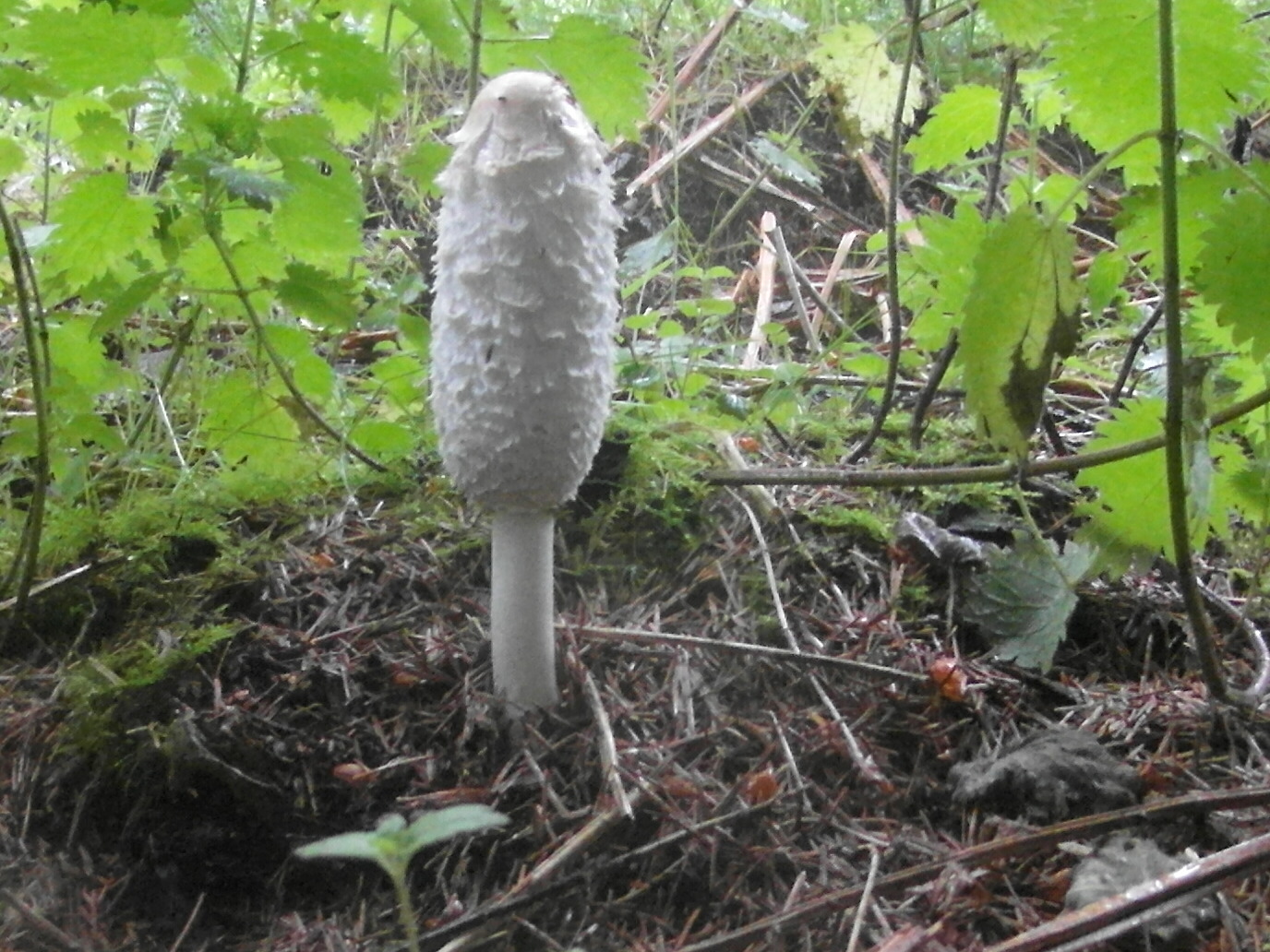
Foraging is a good way to supplement the food basket, get outdoors and tune in with nature, it can be dangerous however, without proper guidance and research fatal mistakes can be made.My friend Louis Smith advises when he takes a group out on a fungi foray, '
There old mushroom hunters and bold mushroom hunters, but there's no old and bold mushroom hunters' sound advice. Louis is co author of 'Forest Fungi in Ireland' a very good guide to what is around and well worth including in your library.
 |
| Red-stalked Boletus 'Boletus erythropus' |
I've been foraging for mushrooms quite a while now and have a hit list that I'm certain with in my local area, all the good ones are on it, there are others that I'm fairly sure of but until I'm in the company of someone I trust, a mental note of location and a photograph is all I will take.
What is a mushroom?
Simply a mushroom/fungi is a fruit body on a mycelium -the web like structure of hypae that run underground or through rotten wood, and leaf litter.I liken it to an apple on a tree.
The purpose of the mushroom is reproduction and it distributes spores 'seeds'.
There are thousands of variations of this 'fruit body', the difference in structure and forms and their particular peculiarities leads into 'classifications'.
This is first achieved by dividing the fungi into two groups. mycetoza - slime moulds- which we will skip and true fungi eumycota which we will focus on.
Eumycota or true fungi are divided into sub-divisions, reasons ranging from structure to spore reproduction.
Gill fungi i.e. saffron milk cap, wood blewitt, tube fungi- boletes, fungi with out gills- i.e. chanterelles, puffballs, Cup and Flask fungi-morels,
These mushrooms/fungi share the fact they need a host to live off as unlike plants they can't produce chlorophyll and use the host as a source of food.
Their relationship with a host will further determine their groupings and habitats.
Mushrooms relationships with their host/habitat.
Parasitic fungi take nutrients and give nothing in return.
Mycorrhizal fungi take the food and in return provide nutrients to the host.
Saprobes decompose dead matter.
Some form a
Symbiotic relationship with a tree or host, so the types of tree in a particular area can lead us to assume certain mushrooms will be found in that area, however there are further complications in the matter, soil type, pollution, soil disturbance and prior climatic conditions.
In looking at true fungi we will be breaking these into three groups; edible, inedible and poisonous.
How can we identify fungi?
In all guides mushrooms will be described in a similar way, Descriptions given will be visual- colour-appearance-shape, olfactory, tactile, habitat, and in some cases taste (this is only in the cases where one is satisfied that the mushroom is not poisonous in any manner).
Cap
The cap will be described along with it’s colour as being of a certain size, shape and any tactile notes I.e. slippery, sticky.
Gills/tubes.
Colour, how they are attached to the stem, size, spacing and shape..
Spores.
Colour when a spore print is made- place a cap gill side down on apiece of white card for 1hr+ and the spores will drop onto the card giving a colour indication. Where similarities are to great a microscope can be used to look at the spores formation.
Stem.
Height, width, shape, the base of the stem, colour, surface, any markings present.
Flesh.
Colour, any discolouration upon cutting, smell, texture. (In the lab mycologist use different chemicals to determine reactions on contact with the flesh )
Habitat.
Trees, soil types, leaf litter, moss, pasture.
Smell.
Differences in smells are used in the identification of mushrooms
Microscopes.
As mentioned above the use of a microscope and chemical agents are used in laboratories to enable the mycologist to clearly define the ‘genus’ family of mushrooms, worldwide variations of species appear in each family. Some guidebooks do contain spore formations as a guide.
Further information can be obtain through books, browsing the web and attending a workshop/hunt.
Fungal names.
Mycologist only apply names in Latin-this method of identification makes research and communication easier as it first gives the family/group/genus name followed by the specific mushrooms species name.
For example
'boletus edulis'.
The first name in Latin tells us that it is from the ‘bolete’ family and the second name ‘edulis’ the specific mushroom from that group. this allows us to know the group and the second is descriptive and it is indeed very edible as the name suggest. Another in this family is called ‘
boletus satanas‘ no prize here for surmising it is bad for your health, though it comes from the ‘
boletus‘ family that provide us with the no 1 mushroom on most list. Boletus are characterised by sponge like tubes where you’d normally expect gills to be.
Common names apply to most mushrooms,Penny Bun, Porcini, Steinpilz, Borowik and Cep are all common names for the '
boletus edulis’, but in different languages.
It's best to familiarise yourself with both Common and Latin names it makes researching and identifying and communication easier.
Edibles.
Those that are consumable, again the similarities to selecting fruit are applied -only specimens that are in good condition should be consumed, those that are old, insect infested or immature, should be left in their habitat. As a general rule when picking mushrooms leave 25% of the type untouched to grow and provide for next year.
Have a hit list of edibles.
Always cook wild mushrooms before consumption. Never ingest large amounts,. Keep a sample.
Inedibles
These are unfit for consumption, and are by far the largest majority of mushrooms. For various reasons, bitter taste, to tough to digest, unpalatable, size -to small to ever be worth picking in the first place aka
little brown jobbies-.
Poisonous
I cannot stress the importance of familiarising yourself with these mushrooms. There are among the same family of mushrooms some that are edible and others that are Deadly!
The A
manita family has some of the most deadly, ‘the death cap’
Amanita phalloides, ‘destroying angel’ A
manita virosa being two that cause liver failure, termed phalloid poisoning,
'the fly agaric’
Amanita muscaria {the red and white one usually depicted with an elf on top in fairytale books}, ‘the panther cap’ A
manita pantherina both contain muscarine poison.
Psychotropic poisoning, caused by magic mushrooms-
psilocybe/ liberty caps- are to be avoided.
Brown roll rims.
Paxus involutous
Yellow stainer.
Agarics xanthoderma
The sickener.
Russula emetica.
Where and when?
When autumn's best, though every thing is weather dependant mushrooms do like a hot summer with some rain late august and nice temperatures to follow during September. long wet periods and cold breezes aren't good.
There are mushrooms in appearance year round though St George's '
Calocybe gambosa' and Common Morels 'Morchella esculenta' usually start the season for most hunters.
Early in the morning and midweek are good times, as there's fewer people around.
While mushrooms can be found in most places and as mentioned earlier the habitat will dictate types. For edibles its best to cover areas of deciduous and coniferous woodland, as these two areas will provide a wide range of habitats that hopefully will provide a wide range of specimens. Of course park land and meadows can provide good habitats but are more likely to have been disturbed by pollution and pesticides.
Remember to keep your bearings when in a new wood /area.
What to wear/bring?
Suitable clothing, Wellingtons/waterproof walking boots, warm clothing, rain gear.
Water, banana, bread or energy bar.
A Light Flat bottomed basket, or cloth bag with stiffened flat bottom {i.e. available at most supermarket tills, stiffen out with extra card board.
Small paper bags or waxed bread wrappers are good for isolating differing types of mushrooms in your bag/basket.
A sharp knife preferably with a folding blade,there are special knifes for mushroom hunters with a bristle brush on one end for cleaning of any dirt before you place your mushroom in the basket.
Do not carry a open blade while walking.
Pen, notebook, Camera 2 build up your own records, take notes and photograph mushrooms you are unsure of for reference later at home.
Mobile phone, also let someone know your intended area of hunt and estimated time. accidents do happen.
RESPECT THE COUNTRYSIDE.
LEAVE THE AREA AS YOU FOUND IT.
FOLLOW ANY INSTUCTIONS INDICATED IN FOREST/PARK LAND.
DO NOT TRESSPASS.
BRING YOUR LITTER HOME.
DO NOT COLLECT SPECIMENS WHEN FIELD IDENTIFICATION WILL SUFFICE.
KEEP DOGS ON LEADS AND SCOOP WHENEVER.
DO NOT DISTURB THE WILD LIFE UNECCESSARILY.
CLOSE ANY GATES THAT YOU MAY OPEN.
A list of my favourite edibles commonly found in the greater Dublin area.
Porcini.
Boletus edulis.
Bay boletes.
Xerocomus badius.
Saffron milk caps.
Lactarius delicious.
Amethyst deceivers.
Laccaria amethystea.
Hedgehog.
Hydnum repandnum.
Giant puffball.
Langermannia gigantea
Chanterelles.
Cantharellus cibarius.
Yellow leg chanterelles.
Cantharellus tubaeformis.
Wood blewitts.
Lepista nuda
Slippery jacks.
Suillus luteus.
Larch bolete.
Suillus grevelli.
Brown birch boletes.
Leccinum scabrum.
 |
| Penny Bun 'Boletus edulis' |
A few of the poisonous mushrooms found in the greater Dublin area.
Death cap.
Amanita phalliodes
Fly agaric.
Amanita muscaria
Panther caps.
Amanita pantherina
Brown roll rims.
Paxus involutous
Yellow stainer.
Agarics xanthoderma
The sickener.
Russula emetica.
.
 |
Fly agaric 'Amanita muscaria'
|
During the course of the season I will post my Finds of edible mushrooms, using the above notes as a guide and hope you can use them as an aide to your forages, naturally there after the responsibility is all your own.
Short clip at Killegar Mushroom Festival, spelt my name wrong must be my accent.
http://www.youtube.com/watch?v=HHjEHgeCndU&feature=youtube_gdata_player
.